
Kidney stones are one of the most common urinary problems and can affect people of all ages. A common question patients ask after a scan shows a kidney or ureteric stone is:
- “Will the stone pass on its own, or do I need surgery?”
The answer depends on several factors—not just the size of the stone. The stone’s location, size, degree of blockage, symptoms, kidney function and presence or absence of infection all influence the treatment decision.
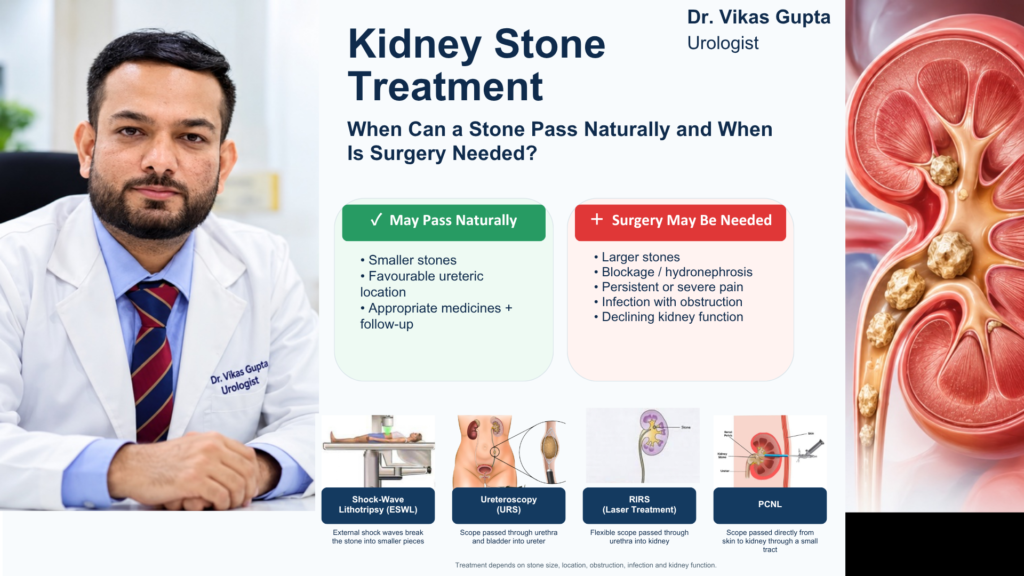
Small stones may pass naturally without surgery, while larger or obstructing stones may require a procedure such as RIRS, ureteroscopy (URS), shock-wave lithotripsy (SWL/ESWL), or PCNL.
- Can a kidney stone pass naturally?
Yes. Small stones, particularly stones that have entered the ureter, may pass naturally during urination.
However, the probability of spontaneous passage decreases as the stone becomes larger. Location also matters: stones located closer to the bladder generally have a better chance of passing than stones located higher up in the ureter.
For an uncomplicated ureteric stone, a period of observation may be appropriate when:
-
- The stone is relatively small
-
- There is no urinary infection
-
- Kidney function is preserved
-
- Pain can be controlled
-
- There is no significant or worsening obstruction
-
- The patient can maintain adequate oral intake
-
- There is appropriate follow-up with imaging when required
For selected uncomplicated ureteral stones up to around 10 mm, guidelines support observation, with medical expulsive therapy using an alpha-blocker considered particularly for appropriate distal ureteral stones.
- Does stone size determine whether surgery is needed?
Stone size is important, but it is not the only factor.
A 4–5 mm stone may pass naturally in one patient, while another patient with a similar-sized stone may require treatment because of persistent obstruction, uncontrolled pain or infection.
In general:
Stones smaller than 5 mm
These have a relatively good chance of passing spontaneously, particularly when they are located in the lower ureter.
Observation and appropriate medical treatment may therefore be reasonable in a suitable patient.
Stones between 5 and 10 mm
Some stones in this range can still pass naturally, but the likelihood is lower than with very small stones.
The decision depends on the stone’s location, symptoms, obstruction and the patient’s preferences.
Stones larger than 10 mm
Spontaneous passage becomes less likely, and a procedure is more frequently considered, particularly when the stone is causing obstruction or persistent symptoms.
However, there is no single stone-size cutoff that automatically means surgery is mandatory.
- Kidney stone vs ureteric stone: Why location matters
A common misconception is that every kidney stone will eventually pass in urine.
A stone sitting inside the kidney may remain there for a long time without causing symptoms. If it moves into the ureter—the narrow tube connecting the kidney to the bladder—it can become lodged and cause renal colic, obstruction and severe pain.
Therefore, when your scan report says “kidney stone,” it is important to know:
Where exactly is the stone located?
Your urologist will consider:
-
- Kidney or ureter
-
- Upper, middle or lower ureter
-
- Stone size
-
- Degree of obstruction
-
- Hydronephrosis
-
- Number of stones
-
- Kidney function
-
- Symptoms and infection status
- When is kidney stone surgery necessary?
Surgery or a stone procedure may be recommended when spontaneous passage is unlikely or when waiting could be harmful or excessively uncomfortable.
Important indications include:
1. Persistent or severe pain
If pain continues despite appropriate medication, definitive treatment may be considered.
2. Significant urinary obstruction
A stone blocking urine flow can cause swelling of the kidney, known as hydronephrosis.
Persistent obstruction should not simply be ignored, particularly when kidney function is affected.
3. Infection associated with obstruction
This is one of the most important situations.
A blocked, infected urinary system is a urological emergency.
A patient with a stone who develops fever, chills, worsening illness, low blood pressure, confusion or other signs of systemic infection needs urgent medical assessment.
In such cases, the priority is usually to drain the infected obstructed kidney, rather than immediately attempting definitive stone removal.
Drainage may be performed with a ureteric stent or nephrostomy, followed by definitive stone treatment after the infection has been appropriately controlled.
4. Declining kidney function
If obstruction is affecting kidney function, waiting for spontaneous passage may not be appropriate.
5. Stone does not pass despite observation
For patients undergoing conservative management, continued observation should not be indefinite.
The AUA guideline recommends definitive treatment when observation/medical expulsive therapy has not been successful after an appropriate period, generally around 4–6 weeks, or earlier when clinically indicated.
6. Recurrent episodes of pain or urinary symptoms
Repeated attacks can significantly affect quality of life and may be a reason to choose definitive treatment.
7. Low likelihood of spontaneous passage
A larger stone, unfavourable location or persistent obstruction may make spontaneous passage unlikely.
- What tests are needed before deciding treatment?
The evaluation depends on the individual patient, but commonly includes:
Ultrasound
Ultrasound can detect kidney stones and hydronephrosis and is useful for assessing the urinary tract without radiation.
CT scan
A non-contrast CT scan of the kidneys, ureters and bladder (NCCT KUB) provides much more detailed information about:
-
- Stone size
-
- Stone location
-
- Stone density
-
- Number of stones
-
- Degree of obstruction
-
- Relevant urinary tract anatomy
CT findings can be particularly useful when planning stone surgery.
Blood tests
Depending on the clinical situation, your doctor may assess:
-
- Serum creatinine
-
- Electrolytes
-
- Complete blood count
-
- Other relevant parameters
Urine examination
Urine routine/microscopy and, when infection is suspected or before intervention as appropriate, urine culture may be required.
The goal is not simply to find the stone, but to determine whether it is safe to wait or whether intervention is advisable.
- What treatments are available for kidney stones?
Treatment depends on stone size, location, composition, symptoms and patient factors.
1. Observation
For selected small, uncomplicated stones, your urologist may recommend waiting for spontaneous passage.
This does not mean ignoring the stone.
Follow-up is important to ensure that the stone has passed or that the kidney is not developing problematic obstruction.
2. Medical Expulsive Therapy
Certain medicines, particularly alpha-blockers, may help facilitate passage of selected ureteric stones, especially distal ureteral stones.
They are not suitable for every patient or every type of stone, so they should be prescribed based on individual assessment.
3. Shock-Wave Lithotripsy (SWL/ESWL)
SWL uses externally generated shock waves to fragment a stone into smaller pieces that can subsequently pass through the urinary tract.
It can be appropriate for selected kidney or ureteric stones.
The effectiveness depends on factors such as:
-
- Stone size
-
- Stone location
-
- Stone composition/density
-
- Patient anatomy
-
- Skin-to-stone distance
4. Ureteroscopy (URS)
During ureteroscopy, a small endoscope is passed through the natural urinary passage into the ureter.
The stone can then be fragmented, commonly using a laser, and fragments may be removed using a basket.
URS is particularly useful for ureteric stones.
5. RIRS — Retrograde Intrarenal Surgery
RIRS is a minimally invasive endoscopic procedure used to treat stones inside the kidney.
A flexible ureteroscope is passed through the urinary tract into the kidney. A laser is then used to fragment the stone, and selected fragments can be removed.
RIRS has become an important treatment option for appropriately selected kidney stones.
6. PCNL — Percutaneous Nephrolithotomy
PCNL is generally used for larger or complex kidney stones.
A small tract is created directly into the kidney through the back, allowing the surgeon to access and remove or fragment the stone.
For large stone burdens, PCNL can provide effective stone clearance and remains an important part of modern kidney stone surgery.
- RIRS, URS, ESWL or PCNL—which one is right for me?
There is no single procedure that is best for every patient.
The choice depends on:
Stone size + stone location + stone density + anatomy + obstruction + symptoms + previous treatment + kidney function + patient preference
For example:
-
- A small distal ureteric stone may be suitable for observation.
-
- A ureteric stone that is unlikely to pass may be treated with URS.
-
- A selected kidney stone may be suitable for RIRS or SWL.
-
- A large or complex kidney stone may require PCNL.
The aim is to choose the treatment that provides effective stone clearance while balancing safety, invasiveness, recovery and the likelihood of needing additional procedures.
- Is every kidney stone dangerous?
No.
Some kidney stones can remain within the kidney without causing symptoms or significant obstruction.
However, a stone should not automatically be considered harmless simply because it is not painful.
Certain stones can grow, migrate into the ureter, cause obstruction, lead to recurrent infection or eventually affect kidney function.
Therefore, the decision to observe a stone should be made after considering the complete clinical and imaging picture.
- Should I drink a lot of water to pass a kidney stone?
Adequate hydration is important for kidney stone prevention and may support urine flow during spontaneous passage.
However, forcing excessive amounts of water during an acute episode of obstruction is not a substitute for medical treatment.
If a stone is obstructing the ureter, drinking very large volumes of water will not necessarily make it pass and may worsen discomfort.
Your fluid intake should therefore be guided by your clinical situation and your urologist’s advice.
- What symptoms mean I should seek urgent medical attention?
Seek urgent medical assessment if you have a suspected or known kidney stone and develop:
-
- Fever or chills
-
- Severe or worsening pain
-
- Persistent vomiting
-
- Difficulty or inability to pass urine
-
- Blood in urine associated with significant symptoms
-
- Markedly reduced urine output
-
- Symptoms suggesting infection
-
- Known obstruction with worsening symptoms
-
- A single functioning kidney with suspected obstruction
Fever associated with an obstructing stone is particularly important and should not be ignored.
An infected obstructed kidney may require urgent drainage.
- Can kidney stones come back after surgery?
Yes.
Stone removal treats the existing stone, but it does not necessarily eliminate the underlying tendency to form stones.
Some patients may therefore develop new stones in the future.
After stone treatment, prevention may involve:
-
- Adequate fluid intake
-
- Dietary modification
-
- Stone analysis
-
- Blood investigations
-
- 24-hour urine evaluation in selected patients
-
- Treatment of specific metabolic abnormalities
The prevention plan should be tailored to the patient’s stone type and metabolic risk factors.
- The most important thing to remember
Not every kidney stone needs surgery—but not every kidney stone should simply be left alone.
A small, uncomplicated ureteric stone may pass naturally with observation and appropriate medical treatment.
On the other hand, persistent obstruction, infection, worsening kidney function, uncontrolled pain or a low likelihood of spontaneous passage may make definitive treatment necessary.
Modern stone treatment offers several minimally invasive options, including RIRS, URS, SWL and PCNL.
The right treatment is determined by the size and location of the stone, the condition of the kidney, symptoms, presence of obstruction or infection, and the patient’s individual circumstances.